
What to expect on OC test day: a parent's practical guide
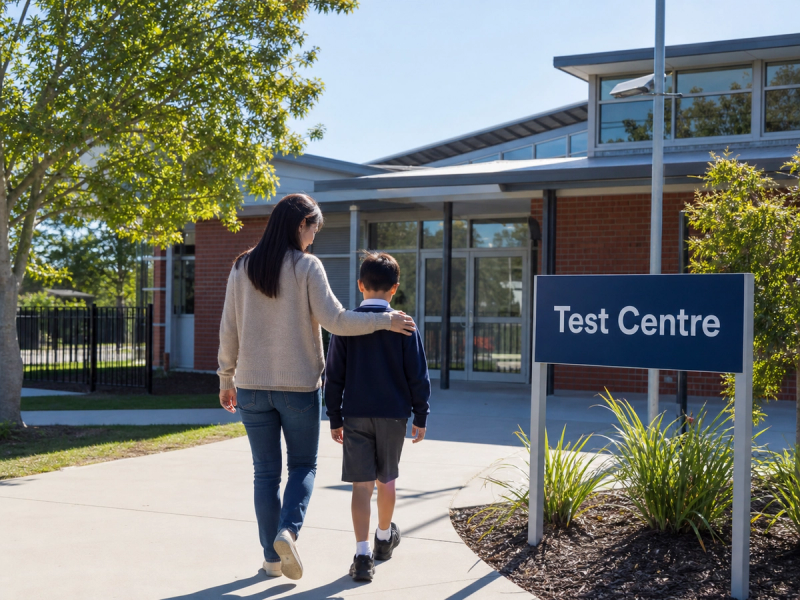
Before you arrive
The OC test is held on a Friday or Saturday in early May at a designated test centre (typically a local high school), not at your child’s school. In 2026, the tests are held on May 8 and May 9 mornings, with the make up test scheduled for May 22. Your admission ticket will confirm the test centre and your arrival time, which is typically 9:30am for registration.
A few things worth knowing before the day:
- Arrive early. There’s a registration process, your child will need to be checked in, and starting flustered is a worse start than starting bored. Give yourself enough time to deal with unexpected traffic and parking constraints.
- Bring a printed copy of the admission ticket. The official guidelines require a printed ticket. Don’t take the chance that the copy on your phone will be accepted.
- Dress in your school uniform. Even if your child is taking the test on Saturday, they’ll need a school uniform. Have them bring a jumper just in case. Test centres have unpredictable temperatures and you don’t want them distracted by being too hot or too cold.
- Bring a water bottle and a snack for after the test. Test centres allow a clear water bottle to be taken into the test room. Snacks may be allowed during breaks, but this isn’t explicitly stated and the DoE has not confirmed that they will be.
- Bring a clear bag for stationery - Your child will need 2 pencils, an eraser and a pencil sharpener
- Leave the digital tools and toys at home. No phones, no smartwatches, no calculators, no notes, no lucky toys. Test centres have strict rules about what’s allowed in the room, and the safest approach is to bring as little as possible.
Arriving and registering
When you arrive at the test centre, look for the OC test signage and follow it. There’ll be a queue of families and a registration desk.
The registration team will explain what happens next — usually you say goodbye at this point, and your child goes through to the test room without you.
This is the moment some children get nervous. They’re walking away from you into a room of strangers to sit a long test. Keep the goodbye brief and warm. A hug, a quick “You’ve got this”, and let them go. Lingering makes it harder for both of you.
You’ll typically be told approximately when to be back to collect them. Use the time to do something else — grab a coffee, take a walk, run some errands. The test is about two hours long, so don’t plan on sitting in a car park.
What the test looks like
The interface is the same one your child will have used if they’ve practised on the official tests or OC Test Prep. Questions appear one at a time. There’s a Next button, a Flag button to mark a question to come back to, and a question navigator showing which questions they’ve answered, skipped, or flagged.
There’s a clock on the screen counting down. Your child can hide it if they find it stressful, but it’s there to help them pace themselves.
The test structure
The OC test has three sections, taken back-to-back with short breaks in between:
- Reading: 14 questions in 40 minutes. Some questions have multiple parts based on a single passage, so the question count is a bit misleading — technically, it will actually be 33 questions that need to be answered.
- Mathematical Reasoning: 35 questions in 40 minutes. About a minute per question. Pacing matters in this section more than any other.
- Thinking Skills: 30 questions in 30 minutes. A minute per question.
There are 10 minute breaks between sections. That’s time to go to the bathroom, take a stretch, drink some water, and reset.
The whole thing takes around two and a half hours including registration and breaks. It’s a long day for your child.
What your child can and can’t do during the test
They can:
- Flag questions and come back to them. This is the single most important navigation feature, and you should make sure they know how to use it before they walk in.
- Change their answers. Until they submit a section, an answer can be changed.
- Use scratch paper and raise their hand for as much additional scratch paper as needed
They can’t:
- Talk to other children
- Go back to a previous section once it’s submitted
- Bring in their own paper, calculators, notes, or any electronic devices
If they have a technical problem, they raise their hand and a supervisor comes over. Technical issues do occasionally happen — a frozen screen, a slow login — and the centres are equipped to handle them. Time lost to genuine technical issues is generally restored.
What not to stress about
A few common worries that turn out not to matter:
- The noise of the keyboard from other children. Your child will adjust within the first minute.
- The strangeness of the test centre environment. Children adapt to new environments faster than adults expect. Within ten minutes of starting, the unfamiliar setting fades into the background.
- Not finishing every section. Most children don’t finish every question in maths or thinking skills, and that’s normal. The test is designed to be ambitious. What matters is the percentage they get right of the questions they do attempt.
- A bad first section. Sections are scored independently, and a slow start in reading doesn’t sink the maths or thinking skills sections. Each new section is a fresh start.
- A single “silly” mistake. There are around 100 questions in total. One careless error is unlikely to change the outcome.
After the test
When your child comes out, the most useful thing you can do is not immediately ask how it went. The test will still be fresh and emotional. They might feel they did badly when they did fine. They might feel they did brilliantly when there were rough patches. Either way, processing happens later.
Go and do something nice. A milkshake, a walk in the park, a movie. Mark the day. Let them tell you about the test in their own time, in their own words — which often happens at random later that day, or even the next morning.
Resist the urge to debrief specific questions. “Did you get the one about the sequences?” leads nowhere good. The test is done. Whatever they remember is what they remember.
When results come and what happens next
Results are typically released by the NSW Department of Education in mid-to-late August, several months after the test. You’ll receive an email or letter with your child’s results and offer status — either an offer to a school on your preference list, a reserve band placement, or no offer.
If your child receives a reserve band offer, that’s a real possibility, not a polite rejection. We’ve written about how OC reserve bands actually work if you want the full picture.
In the meantime, between the test and the results, the most useful test preparation thing you can do is… nothing. The work is done. The decision is out of your hands. Get on with the rest of Year 4.
A final note
The OC test is a long, demanding morning for a ten-year-old. The most useful thing you can do as a parent is help them arrive calm, leave with their head up, and feel proud of having sat the thing at all. The rest is out of your hands.
If your child has been practising on a digital platform that mirrors the real test interface like OC Test Prep, the technical side will already feel familiar — which is one less thing for them to worry about on the morning. That’s the whole point of preparation: to make test day feel like just another practice session, just in a different room.
Whatever happens, they’ve done the work. Walk them in, walk them out, and make the rest of the day easy.